Bring in a vetted expert to train your team with a hands-on, interactive workshop. Flexible formats, proven results, and zero hassle – we handle the matching so you can focus on learning.
Tell us about your team and we'll reach out within 24 hours.
Our team will reach out to within 24 hours.
Our workshop hosts work at


























Skip the one-size-fits-all sessions. Get expert instruction that's relevant, hands-on, and made for your team.
satisfaction rate
faster goal achievement
available workshop hosts

"Andrei has been an amazing mentor, helping me navigate the challenges of managing an engineering team, modernising our legacy SaaS platform and moving us into the era of AI software development."

We're not a generic training marketplace. Every workshop host on MentorCruise is a vetted professional with real-world experience at top companies.

Every host goes through a rigorous vetting process. Only 8% of applicants are accepted, so you're always working with the best.

Workshops start from $250. No hidden fees, no long-term contracts. Pay per session or negotiate a package for your team.

Tell us your goals and team size – we'll match you with the right host, coordinate scheduling, and make sure everything runs smoothly.

No cookie-cutter content. Hosts tailor every session to your team's industry, skill level, and specific challenges.
From first inquiry to post-workshop follow-up, we handle the logistics so your team can focus on learning.
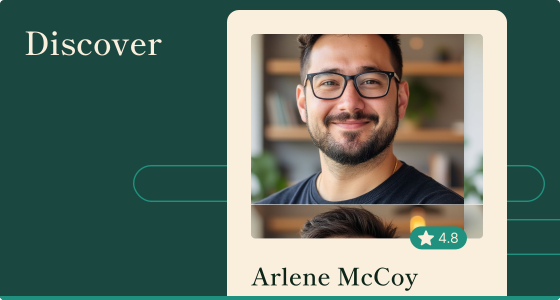
Fill out the quick form or book a discovery call. Share your team's goals, skill gaps, and preferred format – whether it's a focused 2-hour session, a half-day deep dive, or a full-day intensive.
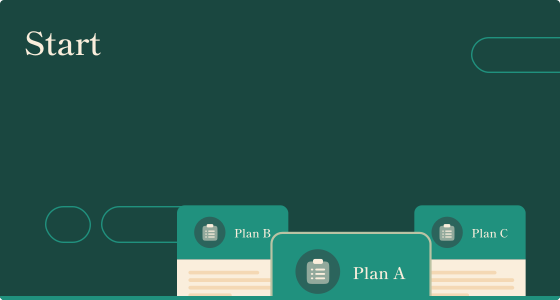
Based on your requirements, we shortlist 2-3 workshop hosts from our vetted network. You'll get their profiles, past workshop topics, and reviews – then pick the one that fits best.

Your host tailors the curriculum to your team's context. They'll align on agenda, exercises, and outcomes ahead of time so there are no surprises – just a session that delivers exactly what you need.

Your team gets a hands-on, interactive session led by a real practitioner. After the workshop, you'll receive materials, action items, and optional follow-up sessions to reinforce what was learned.
Choose a format that fits your team's needs and schedule. Every workshop is fully customizable.
74% of frontline employees now describe themselves as AI users, and only 36% say they have received adequate upskilling (BCG, 2026). AI corporate training closes that distance. A license teaches nobody where a model breaks, or how to tell.
The AI tools arrived on schedule. The training to use them did not, and the gap shows up as output nobody on the team can vouch for - a summary nobody checked, a pull request nobody understood, a number the model invented and everybody believed. That gap is a capability problem, and capability is not something a seat license can install.
What closes a capability gap is guided practice on the team's own work, run by someone who has shipped AI in production and priced per workshop rather than per seat. The rest of this page sets out what that skill consists of, what AI corporate training costs, and what a workshop can't do for a team.
An AI workshop is a live, hands-on training session that teaches a team to use AI tools on the team's own work. An AI workshop usually runs two to eight hours, covers a defined skill set, and ends with the team applying AI training to real tickets, documents, or datasets from the team's own stack.
An AI workshop is a live training session, not an AI-powered app builder or an internal comms tool of a similar name. Most AI workshops are booked by an engineering leader or a learning lead for a single team, and the format sits between a conference talk and a multi-week program.
AI literacy, AI upskilling, and AI enablement are three different purchases, and buying the wrong one is the fastest way to waste an AI training budget. The three terms get used interchangeably often enough that teams pay for a tool demo when what they needed was AI enablement.
Here is what each term means, and what each term is not.
Most teams have bought AI tools and called that purchase AI enablement. The seats are the cheapest part of the work, and a workshop is where AI upskilling actually happens, on the team's real tasks rather than a demo dataset.
A team needs four tiers of AI skills, and most AI training programs deliver only the first two. The tiers run in order, each one rests on the tier below it, and each one has a proof condition - something the team can do afterwards that the team could not do before.
| Tier | Who it covers | What the team can do afterwards | What proves it landed |
|---|---|---|---|
| Tier one, AI literacy | Everyone in the organization | Explain what a model is doing when the model answers, and name the common failure modes | A person can say why an output is wrong, not just that it feels wrong |
| Tier two, prompting and verification | Everyone who touches AI tools in a normal week | Get a reliable output, then check that output against a source before it ships | Someone catches a confident, wrong answer before it reaches a customer |
| Tier three, applied use | The team, on the team's own stack | Use AI on the team's own tickets, docs, and datasets rather than a demo dataset | A real workflow gets faster, and the team can name which one |
| Tier four, judgment | Leads, reviewers, and anyone who ships | Decide which tasks to keep away from the model, and explain the reasoning | A task gets routed away from AI, and the decision survives scrutiny |
Tier two is where prompt engineering sits, and tier two is where most AI training stops. Individuals who want a deeper path can pair a workshop with prompt engineering certifications.
Tier three is where AI capabilities meet the team's real use cases. Teams carrying model workloads of their own often add a machine learning mentor or a data science mentor alongside the workshop.
Most AI training stops at tier two because prompting is the easiest skill to teach and the easiest skill to demo in a sales call, and the numbers show what that produces.
62% of workers say they have received AI training, up 40% in six months. Only 5.5% of the workforce meets the bar for AI proficiency, and 73.5% are "Experimenters" using AI for basic one-off tasks (Section, 2026). Section is itself an AI-training vendor and an interested party, so read the framing with that in mind.
Training volume is up. Proficiency is flat. Running more AI training programs has not produced more capability across the workforce, and that is a design problem rather than an effort problem.
The design failure is specific. A two-hour session on prompting teaches a person to get an answer out of a model, and nothing in that session teaches the same person to check the answer, apply it to the team's own work, or decide the model should never have been asked.
Tier two skill without tier three and tier four produces a team that ships more output and trusts it less.
Tier four is judgment about where not to use AI, and tier four is what stops AI from making a team measurably worse. The evidence is a pre-registered randomized trial, not a vendor survey.
On a task chosen to sit outside AI's reliable range, consultants using AI were 19 percentage points less likely to produce a correct solution than consultants working without AI (Dell'Acqua et al., 2023, Harvard Business School Working Paper 24-013). Untrained AI use on the wrong task is worse than no AI at all.
Inside that reliable range, the same 758-person trial found consultants completed 12.2% more tasks, 25.1% faster, at more than 40% higher quality. The model is powerful exactly where the model is powerful, and quietly harmful just outside.
The trial also found below-average performers improved 43% while above-average performers improved 17%. The lift is largest where the skill is lowest, which is the argument for training a whole team instead of the three people who already volunteered.
Tier four is the skill that tells a person which side of that line a task sits on. Without it, an AI-fluent team ships more work, faster, and some of that work is confidently wrong.
An AI workshop is the only one of the three formats that puts a practitioner in a room with the team's own work. An online course and a conference session are cheaper per head, and neither one checks whether the skill landed.
The axis that matters is who sets the content. A course catalog ships the same module to every buyer. A workshop host reviews the team's tools and skill level before building the exercises.
| Dimension | AI workshop | Online course | Conference session |
|---|---|---|---|
| Who sets the content | The host, after a review of the team's tools and skill level | The catalog vendor, fixed in advance for every buyer | The speaker, for a room of strangers |
| Feedback loop | Live, in the room, on the team's own output | Quizzes and auto-graded exercises | None |
| What the team practices on | The team's own tickets, docs, and datasets | A generic demo dataset | Nothing, the team watches |
| Typical time commitment | Two to eight hours, booked as a single block | Self-paced, and usually abandoned partway | Forty-five to sixty minutes |
| How it is priced | Per workshop, for the whole group | Per seat, per year, used or not | Per ticket, per attendee |
The customization difference is measurable. Persona-based learning journeys have been shown to deliver employee AI adoption 20 times higher than a broad-based approach (BCG, 2026). The same analysis puts 10% of AI value creation in the algorithms, 20% in the technology infrastructure, and 70% in people, processes, and change management, which is a long way of saying the tool is the cheap part.
Courses carry a second problem. Skills needed for the most AI-exposed jobs are changing more than twice as fast as skills for the least exposed jobs (PwC, 2026), so a generative AI course bought once goes stale fastest exactly where the exposure is highest.
A free online course is a reasonable way for one person to learn the basics of generative AI. A conference session is a reasonable way to hear what other teams are doing. Buy a workshop when the team needs to practice on the work it actually ships.
AI corporate training costs $1,000 to $3,000 per day per person for in-person workshops, and $12,000 to $250,000 for a corporate package depending on scope (published cost benchmarks, Bizzuka, 2024). MentorCruise prices AI corporate training per workshop instead, with a 2-hour Fundamentals session from $250 for 5-20 people, a 4-hour Deep Dive from $500 for 10-30 people, and a 6-8 hour Bootcamp from $900 for 10-50 people.
| Pricing model | How the price scales | Published price | Price visibility |
|---|---|---|---|
| Per-seat public class | Multiplies with every person added | $495 per student, four-hour class | Published on the vendor's own site |
| Per-workshop, as MentorCruise sells it | Flat for the group, inside the size band | From $500 for a four-hour Deep Dive | Published, with group sizes attached |
| Enterprise custom engagement | Negotiated per program, quote only | One published rate is $75,000 plus travel, half-day | Occasionally published, usually not |
| Self-paced catalog subscription | Per seat, per year, whether used or not | An annual license fee per learner | Rarely published |
The arithmetic is the argument. One of the few providers that publishes a price at all charges $495 per student for a four-hour public class. Its private and custom workshops are unpriced, which is the norm: most providers quote on request, so a team cannot compare before it enquires.
A four-hour Deep Dive from MentorCruise is from $500 for a group of 10 to 30 people, total. The difference is the pricing model, not a discount. A per-seat rate taxes a team for the one thing that makes training work, which is training everybody rather than the keenest three. A per-workshop rate does not, and a published one lets a team do the sum before it books.
At the other end of the market, one published workshop rate starts at $75,000 plus travel. And 14 of 16 providers on this search publish no price at all, which is why an enterprise AI training buyer usually cannot compare two quotes without first booking two sales calls.
Price visibility is itself a signal. A provider that will not name a number before a discovery call has optimized for the call, not for the buyer.
Start with the person teaching it, because that is the question this market is least prepared to answer. Five questions separate a real AI training provider from a slide deck, and each one is a question the buyer asks out loud before signing anything.
Ask who is teaching it, and what that person has actually shipped. MentorCruise accepts 8% of workshop-host applicants, and a host is a practitioner who has shipped AI in production rather than a professional trainer. An automated scan of all 16 competitor pages on this search for any vetting language returned zero matches, and most never say who teaches the training at all.
Ask for the price before the discovery call. 14 of 16 providers publish no price at all, which means the first hour of the buying process gets spent extracting a number that should have been on the page. The pricing table above gives the four models and what each one costs a 15-person team.
Check that the training clears five hours. Regular AI usage is sharply higher for employees who receive at least five hours of training and have access to in-person training and coaching (BCG, 2025), and workers trained to use AI are up to 19 times as likely to report AI is improving their productivity (Slack Workforce Index, 2024). MentorCruise's own 2-hour Fundamentals workshop does not clear that five-hour threshold. Fundamentals is a trial rather than a program, and it is the cheapest way to find out whether live training works on a particular team before committing real budget. The 4-hour Deep Dive and the 6-8 hour Bootcamp are the formats that reach the dose.
Ask what gets built around your team, and what is stock. A workshop host reviews the team's tools and skill level before building the exercises, so the team practices on its own tickets instead of a demo dataset. A provider that cannot describe that review step is selling a fixed module with the buyer's logo on the title slide.
Ask how fast someone can be in front of the team. MentorCruise matches a vetted workshop host to a team within 48 hours. A scan of all 16 competitor pages for any matching or turnaround commitment returned zero matches, because the competitive set's purchase unit is an annual contract or a custom quote rather than a workshop.
An AI workshop can't close an enterprise value gap on its own. 88% of organizations report regular AI use in at least one business function, only 39% attribute any level of EBIT impact to that use, and nearly two-thirds have not begun scaling AI across the enterprise (McKinsey, 2025).
That gap does not close because 15 people got better at prompting. A workshop raises the capability of the people who would otherwise have to close it without the skill, and the rest of the work sits outside a training room.
Four things sit outside a workshop's scope, and each one has a page of its own.
And a two-hour session is a trial, not a program. Naming those limits up front is cheaper than discovering them in month three.
An AI workshop moves the capability of the people in the room. Everything downstream of that - measurement, policy, workflow, rollout - is separate work, and pretending otherwise is how AI training programs lose their credibility.
Serious engineering organizations are booking AI corporate training right now, and MentorCruise received 29 inbound requests for AI workshops between May 2026 and July 2026. The buyers are engineering leaders, L\&D leads, and CTOs with a live skills gap and a team that already has the tools.
Most arrive after an internal rollout produced adoption numbers and no change in output.
The pressure behind that is competitive. Only 5% of companies are achieving AI value at scale, 60% are not achieving material value at all despite substantial investment, and leaders expect to upskill more than 50% of employees in AI against 20% at laggards (BCG, 2025).
The buyers are also clear about what they are buying. Insufficient worker skills is the biggest barrier to integrating AI into existing workflows, and leaders name educating the broader workforce (53%) and upskilling strategies (48%) ahead of hiring specialized talent (36%) (Deloitte, 2026).
Those buyers land on a workshop rather than a hire because of speed. Hiring an AI-fluent engineer is slow, and an 8% acceptance rate on workshop hosts means the person standing in front of the team has already done the job. Teams that need the leadership layer as well often add an engineering management mentor.
At least five hours, if the goal is a durable change in how the team works. Regular AI usage is sharply higher for employees who get that dose plus in-person coaching (BCG, 2025). MentorCruise runs three formats, a 2-hour Fundamentals session, a 4-hour Deep Dive, and a 6-8 hour Bootcamp, and Fundamentals sits below the threshold on purpose, as a low-cost trial rather than a program.
It depends on who is taking the class, and a free online AI class is genuinely fine for one person learning the basics of generative AI on their own time. An AI class fails when a company buys it for a team and nobody ever checks whether the skill landed on the team's real work. For an individual who wants ongoing help instead of a course, AI coaching for individuals is the closer fit.
Yes, the workshop host reviews the team's tools, codebase, and skill level before building the exercises, so the team practices on its own tickets and documents rather than a demo dataset. A fixed course catalog structurally cannot do that, because the catalog was built before the buyer existed. That intake happens between booking and delivery, and it is where most of a workshop's value gets decided.
Yes, and the tiering is what makes it work. Tier one and tier two, AI literacy then prompting and verification, are the same skills for marketing, finance, and operations as for engineering. Tier three is where the content diverges, because the team's own use cases are the raw material for the exercises, and teams building AI into a product often pair a workshop with an AI product management mentor.
Scale and procurement, not content. An enterprise AI training program is a rollout across many teams with an org-wide plan behind it, a budget cycle, and a procurement process attached. A single workshop is one team, one host, and one block of time, and organizations that need the rollout should start with an AI transformation workshop instead of booking a single session.
Tell MentorCruise the team size, the topic, and the skill level, and a vetted workshop host is matched within 48 hours. Request a workshop with the form at the top of this page. The intake takes a few minutes and asks for team size, the tools the team already uses, and the tier the team is starting from.
The host runs an intake call before the session, builds the exercises around the team's own work, and delivers the workshop on a date the team picks. The unit of purchase is one workshop, not a seat count and not an annual contract.
Individual professionals who want ongoing help rather than a team session can find an AI mentor instead.
Our hosts are experienced professionals from leading companies who bring real-world expertise to every session. Here's a sample of who's available.

Senior Product Manager, AI at Uber

CEO at Engineering Peak Impact

Principal UX, Service Design & AI Strategy at Aragon Consulting

B2B Marketing & Startup Leader | 3x exits at Cold.inc
CEO | Fractional C- Suite at Inside Startups

Product GTM Strategy & Operations at Amazon

World-wide Head of Engineering and Product at Amazon

Group Product Manager at ING
See all our corporate training programs – AI tools, leadership, sales, marketing and more.
Reviews
Andrei has been an amazing mentor, helping me navigate the challenges of managing an engineering team, modernising our legacy SaaS platform and moving us into the era of AI software development.
Patrick
Director, Strategic Projects

Alessandro taught me to use competency matrices as objective decision-making tools, challenge assumptions from my own teams, and translate technical language into management language for executive conversations.
Roman
Engineering Manager

Matthew helped me think through several tricky leadership moments – particularly around how to navigate executive relationships, clarify influence, and prepare for a high-stakes offsite. I left each session clearer, calmer, and more confident in how I was showing up at the executive level.
Kimmy
Director of Team Enablement
Ready when you are
Tell us your goals and team size. We'll match you with 2-3 vetted hosts within 48 hours.



