Bring in a vetted expert to train your team with a hands-on, interactive workshop. Flexible formats, proven results, and zero hassle – we handle the matching so you can focus on learning.
Tell us about your team and we'll reach out within 24 hours.
Our team will reach out to within 24 hours.
Our workshop hosts work at



























Skip the one-size-fits-all sessions. Get expert instruction that's relevant, hands-on, and made for your team.
satisfaction rate
faster goal achievement
available workshop hosts

"Türker taught us the fundamentals and gave us a peek into how things work in the industry, helping us apply the same principles despite our unique challenges. You're guaranteed to leave every session with valuable tools and frameworks."

We're not a generic training marketplace. Every workshop host on MentorCruise is a vetted professional with real-world experience at top companies.

Every host goes through a rigorous vetting process. Only 8% of applicants are accepted, so you're always working with the best.

Workshops start from $250. No hidden fees, no long-term contracts. Pay per session or negotiate a package for your team.

Tell us your goals and team size – we'll match you with the right host, coordinate scheduling, and make sure everything runs smoothly.

No cookie-cutter content. Hosts tailor every session to your team's industry, skill level, and specific challenges.
From first inquiry to post-workshop follow-up, we handle the logistics so your team can focus on learning.
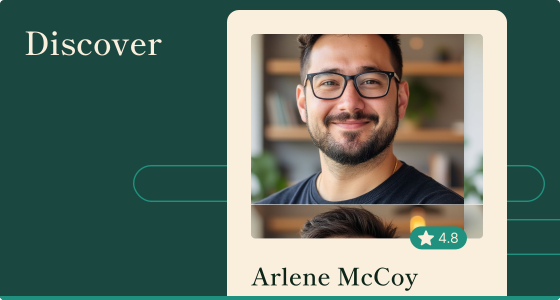
Fill out the quick form or book a discovery call. Share your team's goals, skill gaps, and preferred format – whether it's a focused 2-hour session, a half-day deep dive, or a full-day intensive.
Based on your requirements, we shortlist 2-3 workshop hosts from our vetted network. You'll get their profiles, past workshop topics, and reviews – then pick the one that fits best.

Your host tailors the curriculum to your team's context. They'll align on agenda, exercises, and outcomes ahead of time so there are no surprises – just a session that delivers exactly what you need.
Your team gets a hands-on, interactive session led by a real practitioner. After the workshop, you'll receive materials, action items, and optional follow-up sessions to reinforce what was learned.
Choose a format that fits your team's needs and schedule. Every workshop is fully customizable.
Design thinking delivers ROI of 85% or greater, according to Forrester Research - but only when teams practice the methodology together on real problems, not when individuals watch videos about it. The practical difference between a workshop and a self-paced course comes down to one thing: facilitation under pressure.
A $49 Coursera course teaches the five stages - empathize, define, ideate, prototype, and test - as a framework to memorize. A facilitated workshop forces a team to use them on a live business challenge where stakes are real and groupthink is the default.
Design-thinking sessions outperform traditional learning methods in boosting team effectiveness and creativity (Charter Works, 2025). That advantage comes from creative problem solving under expert facilitation - something a solo learner can't replicate by pausing and replaying a lecture. When a facilitator catches a team defaulting to their first idea during ideation or skipping user research during empathy exercises, that correction changes behavior in ways no course module can.
Design thinking workshops teach five stages - empathize, define, ideate, prototype, and test - through hands-on exercises that teams apply to real business challenges during the session. The methodology is the applied form of human-centered design: every stage forces the team to center decisions on actual user needs rather than internal assumptions. Teams don't just learn a framework. They practice it under pressure, with a facilitator correcting course in real time.
Empathize fixes assumption-driven product decisions. Instead of surveying users with leading questions, teams practice empathy mapping - building a structured view of what users say, think, do, and feel. The exercise surfaces blind spots that months of internal meetings miss. Most product teams are surprised by how much they've been assuming about their users - the empathize stage makes those assumptions visible and testable.
Define prevents scope creep. Most teams skip straight from "we talked to users" to "let's build something." The define stage forces a specific, actionable problem statement. It's the most expensive problem-solving mistake a team can make: solving the wrong problem.
A good facilitator won't let the team move forward until the problem statement is sharp enough to test. This gatekeeping is where the facilitation investment pays off most directly.
Ideate breaks groupthink. Left to their own devices, most teams converge on the first idea the most senior person suggests. Facilitated ideation uses structured divergent thinking - silent brainstorming, "yes, and" rounds, constraint removal - to generate 10x more options before narrowing down. Expert facilitation keeps ideation sessions productive instead of devolving into dominant-voice dynamics.
Prototype reduces build cost. Low-fidelity prototyping teaches teams to test ideas in hours instead of building for months. A paper prototype, a clickable wireframe, or a role-played service interaction costs almost nothing and surfaces major flaws before engineering resources are committed.
Test catches user friction early. Teams put their prototype in front of real users during the workshop itself. The feedback loop is immediate - not a quarterly review three months after launch. One round of user testing during a workshop can prevent weeks of post-launch rework.
The five stages aren't linear in practice. A good facilitator teaches teams when to loop back - when testing reveals that the problem statement from the define stage was wrong, or when prototyping surfaces new empathy gaps.
That iterative instinct is what separates teams that "know" design thinking from teams that actually use it. IDEO and Stanford's d.school developed this iterative approach, and it remains the foundation of how the methodology is taught and applied today.
Teams looking to deepen their practice beyond the workshop often pair it with ongoing UX design mentors or product management mentors who reinforce the methodology on live projects.
Mature design thinking practices generate ROI of 85% or greater - which means a $500 workshop pays for itself if the team avoids one misguided product sprint (Forrester, 2020). That's not a theoretical projection. It's measured across organizations that embedded design thinking into ongoing team practice.
Enterprise teams using design thinking delivered over 300% ROI, with faster time-to-market, reduced design and development rework, and improved cross-functional alignment (IBM/Forrester Total Economic Impact Study, 2018). The key detail: the ROI came from teams that practiced the methodology on real projects, not from a one-time training event.
The workshops were the starting point, and the returns compounded as teams applied what they learned. A 97% satisfaction rate across all MentorCruise workshop formats reflects this pattern - teams that practice on real problems during the session report higher satisfaction because the output is immediately applicable, not theoretical.
Design thinking builds three capabilities that compound: customer-centricity, cross-functional collaboration skills, and tolerance for ambiguity - findings from a six-year study across 30+ organizations (Liedtka, 2018, University of Virginia). These aren't one-time outputs. They're behavioral changes that improve how teams work long after the workshop ends.
A 2024 systematic review in the Journal of Organization Design confirmed design thinking's measurable impact on team interactions, skills, and performance. The research consistently shows design thinking delivers strongest results at the team level, not as individual skill development. This is why workshops - where the team practices together - outperform courses where individuals learn alone.
L\&D teams increasingly use design thinking workshops as leadership development tools because facilitation skills transfer directly to team management. The ability to run a structured ideation session, facilitate divergent thinking, and synthesize competing viewpoints are leadership skills disguised as design skills. Innovation training that doubles as leadership development is a stronger budget justification than either alone.
The right format depends on team size, prior experience with design thinking, and whether the goal is awareness, capability building, or project kickoff. Choosing wrong wastes your team's time - a 2-hour session can't cover prototyping in depth, and a full-day bootcamp is overkill for teams that just need an introduction.
| Attribute | Fundamentals (2 hours) | Deep Dive (half day) | Bootcamp (full day) |
|---|---|---|---|
| Duration | 2 hours | 4 hours | 6-8 hours |
| Group size | 5-20 people | 10-30 people | 10-50 people |
| Prior experience required | None | Basic awareness helpful | None, but higher engagement with some exposure |
| Primary outcome | Shared vocabulary and awareness | Applied skill in 2-3 stages | End-to-end design sprint with tested prototype |
| Typical use case | Leadership buy-in session, team kickoff | Cross-functional project team building capability | Product team launching a new initiative |
| Starting price | From $250 | From $500 | From $900 |
Every format is customized to the team's industry and learning objectives - not a standard slide deck delivered identically to every client. The facilitator reviews the team's context before the session and adapts exercises to real problems the team is currently facing.
The fundamentals session works best as a starting point for teams with no prior exposure. It builds shared vocabulary and gives leadership a firsthand experience of the methodology before committing to a longer engagement. Many teams start with a fundamentals session and follow up with a deep dive once they've identified which stages need the most practice.
The deep dive is the most popular format for cross-functional teams. Four hours is enough time to practice 2-3 stages in depth - typically empathize and ideate, or prototype and test - while keeping the session focused enough that participants don't lose energy.
For teams ready to commit to a full-day session, the bootcamp format mirrors a compressed design sprint. Teams complete one full cycle from empathy research to tested prototype, leaving with tangible output they can develop further. Virtual and in-person options are available for all three formats.
The pricing is transparent - no "request a quote" gatekeeping. Final pricing depends on group size, customization depth, and delivery mode. This matters because most competitors require a sales conversation before revealing any pricing, which adds friction and delays the decision.
The facilitator determines whether a workshop produces lasting behavioral change or just fills a training checkbox. The quality of design thinking training depends more on who runs it than what slides they use.
A mediocre facilitator reads from a deck. A good one reads the room, adapts exercises mid-session, and pushes teams past comfortable consensus into genuine creative tension.
Here's what to evaluate when comparing workshop providers:
Stanford's d.school has trained 4,000+ business leaders since 2008 - that's the caliber of facilitator background MentorCruise screens for. Only 8% of applicants are accepted as workshop hosts. That selectivity is the difference between a facilitator who adapts exercises to your team's context and one who runs the same generic deck for every client.
The vetting process evaluates real delivery experience, not just certifications. A consultant who has run 50 workshops for enterprise teams brings a different skill set than someone who completed a weekend certification course.
Matching, scheduling, and coordination are handled within 48 hours so the buyer focuses on learning objectives, not admin. Teams seeking ongoing design sprints coaching after the workshop can connect with facilitators who offer extended programs that combine workshop delivery with follow-up coaching.
Here's the honest limitation: even a great facilitator can't guarantee behavior change if the organization doesn't support post-workshop implementation. A workshop plants the seed. Whether it grows depends on what happens in the weeks after - which is the single biggest factor most providers don't address.
The workshop's value is determined in the weeks after it ends. Teams that apply design thinking to an active project within 7 days retain the methodology. Teams that don't revert to old habits within a month.
This is the gap that separates design thinking training that sticks from expensive "workshop tourism."
Liedtka's research found design thinking produces lasting organizational change only when teams continue practicing after initial training (Liedtka, 2018). The methodology requires deliberate, repeated application before it becomes second nature.
Here's a practical strategy for post-workshop retention:
Because each workshop is tailored to a real project the team is working on, they leave with prototype output they can keep developing - not just notes from hypothetical exercises. This built-in momentum is the strongest predictor of post-workshop retention.
The facilitator's job doesn't end when the session ends. A good workshop host provides a follow-up summary, identifies which team members showed the strongest facilitation instincts, and recommends next steps based on where the team struggled. That handoff document is the bridge between a workshop and lasting practice.
The teams that get the most from design thinking training treat the workshop as a starting point, not a finish line. Embedding design thinking into your team's working rhythm requires a deliberate strategy, not just good intentions.
Collaboration between team members deepens with each cycle, and the design thinking vocabulary becomes a shared language for making decisions under uncertainty. AI tools can support some parts of the process - particularly during research and prototyping stages - but the core methodology remains a fundamentally human, team-based discipline.
A design thinking workshop is a structured, facilitator-led session where teams practice the five stages of human-centered design - empathize, define, ideate, prototype, and test - on a real business challenge. Unlike self-paced courses that teach theory, workshops create a live practice environment with expert facilitation and immediate feedback. Sessions range from 2-hour introductions to full-day bootcamps depending on the team's goals.
The five stages are empathize, define, ideate, prototype, and test. In the empathize stage, teams observe and interview real users. Define narrows findings into a specific problem statement.
Ideate generates multiple solutions through structured brainstorming. Prototype turns the best ideas into low-fidelity models. Test puts prototypes in front of users for feedback before committing resources to build.
Design thinking workshops on MentorCruise start at $250 for a 2-hour fundamentals session, $500 for a half-day deep dive, and $900 for a full-day bootcamp. Pricing is published upfront - no sales call required.
Final cost depends on group size, customization depth, and whether the session is virtual or in-person. Most competitors require a "request a quote" process, which adds days of back-and-forth before teams can compare providers.
Teams that practice design thinking develop customer-centricity, cross-functional collaboration, and faster prototyping cycles - behavioral changes that outlast any single workshop. Research across 30+ organizations found these capabilities compound over time, improving how teams work together on every subsequent project (Liedtka, 2018).
The methodology is particularly effective for teams stuck in assumption-driven decision-making or siloed working patterns. A design mentor for ongoing practice can help individual team members continue developing these skills beyond the initial workshop.
Our hosts are experienced professionals from leading companies who bring real-world expertise to every session. Here's a sample of who's available.

Senior UX Design Manager at Apple | ex-Google, ex-Microsoft

Senior ML Software Engineer at Meta (IG Ads)

Senior Product Designer at Mastercard

Digital and AI Content Lead at Burberry

Principal UX, Service Design & AI Strategy at Aragon Consulting

Staff UX Designer / UX Design Lead at HelloFresh

AI Product Lead at Amazon

Senior Product Designer at Typeform
See all our corporate training programs – AI tools, leadership, sales, marketing and more.
Reviews

Andrei has been an amazing mentor, helping me navigate the challenges of managing an engineering team, modernising our legacy SaaS platform and moving us into the era of AI software development.
Patrick
Director, Strategic Projects

Alessandro taught me to use competency matrices as objective decision-making tools, challenge assumptions from my own teams, and translate technical language into management language for executive conversations.
Roman
Engineering Manager

Matthew helped me think through several tricky leadership moments – particularly around how to navigate executive relationships, clarify influence, and prepare for a high-stakes offsite. I left each session clearer, calmer, and more confident in how I was showing up at the executive level.
Kimmy
Director of Team Enablement
Ready when you are
Tell us your goals and team size. We'll match you with 2-3 vetted hosts within 48 hours.



