Bring in a vetted expert to train your team with a hands-on, interactive workshop. Flexible formats, proven results, and zero hassle – we handle the matching so you can focus on learning.
Tell us about your team and we'll reach out within 24 hours.
Our team will reach out to within 24 hours.
Our workshop hosts work at


























Skip the one-size-fits-all sessions. Get expert instruction that's relevant, hands-on, and made for your team.
satisfaction rate
faster goal achievement
available workshop hosts

"Türker taught us the fundamentals and gave us a peek into how things work in the industry, helping us apply the same principles despite our unique challenges. You're guaranteed to leave every session with valuable tools and frameworks."

We're not a generic training marketplace. Every workshop host on MentorCruise is a vetted professional with real-world experience at top companies.

Every host goes through a rigorous vetting process. Only 8% of applicants are accepted, so you're always working with the best.

Workshops start from $250. No hidden fees, no long-term contracts. Pay per session or negotiate a package for your team.

Tell us your goals and team size – we'll match you with the right host, coordinate scheduling, and make sure everything runs smoothly.

No cookie-cutter content. Hosts tailor every session to your team's industry, skill level, and specific challenges.
From first inquiry to post-workshop follow-up, we handle the logistics so your team can focus on learning.
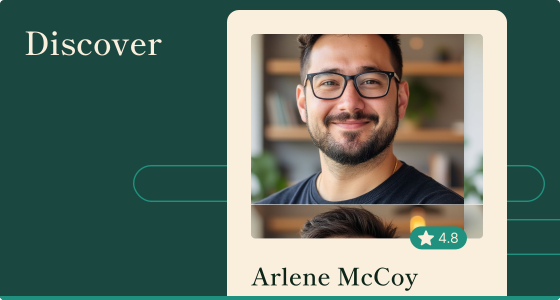
Fill out the quick form or book a discovery call. Share your team's goals, skill gaps, and preferred format – whether it's a focused 2-hour session, a half-day deep dive, or a full-day intensive.
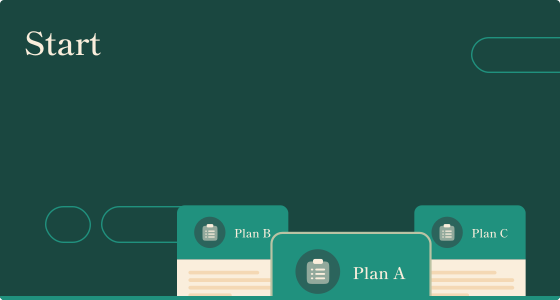
Based on your requirements, we shortlist 2-3 workshop hosts from our vetted network. You'll get their profiles, past workshop topics, and reviews – then pick the one that fits best.

Your host tailors the curriculum to your team's context. They'll align on agenda, exercises, and outcomes ahead of time so there are no surprises – just a session that delivers exactly what you need.
Your team gets a hands-on, interactive session led by a real practitioner. After the workshop, you'll receive materials, action items, and optional follow-up sessions to reinforce what was learned.
Choose a format that fits your team's needs and schedule. Every workshop is fully customizable.
Companies that invest in design see 32% higher revenue growth (McKinsey Design Index). Yet most design teams still run their UX workshops as internal meetings with sticky notes and no facilitator - missing the structured methodology that separates productive collaborative sessions from wasted afternoons.
UX design workshops produce better outcomes than courses or internal meetings because they combine expert facilitation with hands-on practice on the team's own products. A course teaches empathy mapping as a concept. A workshop makes your team practice it on your actual user data, with a facilitator who corrects technique in real time.
The difference shows up in deliverables: workshops produce journey maps, prioritized backlogs, and design decisions that the team owns collectively - not slides that sit in a shared drive. The facilitator is the variable that separates a productive session from another meeting with a whiteboard - and the ROI data backs that up.
UX workshops break into five types - discovery, empathy, design, prioritization, and critique - each serving a different phase of the design process and requiring different time commitments. Nielsen Norman Group's widely adopted taxonomy identifies these five categories, and the common thread across all of them is the diverge-and-converge pattern: teams generate ideas broadly, then narrow down to the strongest options through structured decision-making.
Choosing the right type depends on where the team is in the product lifecycle. A team with no user research needs a discovery workshop. A team drowning in research but unable to agree on priorities needs a prioritization workshop.
The table below maps each type to its use case.
| Workshop Type | Duration | Ideal Group Size | Key Activities | Deliverables | Common Use Case |
|---|---|---|---|---|---|
| Discovery | Half-day to full-day | 6-10 | Stakeholder interviews, How Might We questions, affinity diagramming | Research brief, problem statement | New product launches, entering new markets |
| Empathy | 2-4 hours | 6-12 | Empathy mapping, persona creation, user interviews | Empathy maps, user personas | Teams starting user research, building shared understanding |
| Design | 1-2 days | 6-8 | Crazy 8s, storyboarding, prototyping | Wireframes, concept sketches, testable prototypes | Ideation sprints, turning research into solutions |
| Prioritization | 2-4 hours | 8-12 | Dot voting, MoSCoW prioritization, impact-effort matrices | Prioritized backlog, decision log | Roadmap planning, feature selection |
| Critique | 1-2 hours | 4-8 | Structured feedback rounds, Rose/Thorn/Bud, heuristic evaluation | Annotated designs, action items | Design reviews, pre-launch quality checks |
Discovery and empathy workshops suit teams early in the design process - before solutions exist. Design workshops fit teams ready to generate ideas. Prioritization and critique workshops serve teams that need to converge on decisions or evaluate existing work.
Discovery workshops surface user needs and business requirements before the team starts designing. They work best when a team is entering a new market or launching a new product and hasn't yet agreed on what problem they're solving. The output - a research brief and shared problem statement - prevents the most expensive UX mistake: building something nobody asked for.
Empathy workshops go deeper into user psychology. Where discovery asks "what do users need?", empathy asks "what do users feel?" Teams practice empathy mapping, documenting what users say, think, do, and feel across their experience. A UX research mentor can help teams build this capability beyond a single workshop, but the workshop itself produces personas and empathy maps that ground design decisions in user reality rather than assumptions.
Design workshops apply design thinking principles to generate and refine solutions. Crazy 8s - eight ideas in eight minutes - breaks the perfectionism that slows most teams during ideation.
Storyboarding connects individual screens into user flows. Prototyping turns sketches into testable concepts.
These sessions map to MentorCruise's Deep Dive (half-day) or Bootcamp (full-day) formats, depending on scope. A half-day session covers ideation and initial concepts. A full-day session adds prototyping and a first round of internal critique.
Teams working on design sprints coaching often use design workshops as the core activity within a sprint week.
Prioritization workshops help teams rank capabilities and decide what to build next using frameworks like dot voting and impact-effort matrices. Dot voting gives every participant equal weight in decisions - a counterweight to the loudest-voice-wins dynamic in most meetings. These sessions run 2-4 hours and produce a prioritized backlog that product and engineering can act on immediately.
Critique workshops are the shortest format (1-2 hours) and the most focused. Teams evaluate existing designs against usability heuristics and specific user scenarios. The deliverable is annotated designs with clear action items, not vague feedback.
Critique workshops work best when the team has something tangible to evaluate - wireframes, prototypes, or a live product.
The most effective UX workshop activities - empathy mapping, customer journey mapping, dot voting, and Crazy 8s - work because they force collaborative decision-making rather than individual opinions. Each activity produces a tangible artifact that the team can reference long after the workshop ends.
Research activities give teams structured methods to move from assumptions to evidence. The most common workshop research activities produce deliverables that drive product decisions for months:
The activities a facilitator selects depend on the team's maturity. A junior design team needs empathy mapping basics with guided templates. A senior team benefits from advanced critique frameworks like Rose/Thorn/Bud, where they evaluate designs across what's working, what's not, and what has potential.
What makes these activities valuable isn't the technique itself - it's the collaborative structure. Empathy mapping done solo is just note-taking. Empathy mapping done with six team members from product, engineering, and design surfaces contradictions and blind spots that no individual perspective catches.
The workshop format forces those conversations to happen in real time, with a facilitator who keeps the discussion evidence-based rather than opinion-driven.
Ideation activities shift teams from analysis to creation. The goal isn't polished solutions - it's volume and variety:
These aren't creative exercises for their own sake. They produce strategic artifacts - personas, journey maps, prioritized backlogs - that drive product decisions. A team using Figma for design work or Miro for remote collaboration can integrate workshop outputs directly into their existing tools, keeping workshop deliverables accessible rather than buried in a shared drive.
The sequencing matters as much as the selection. A well-facilitated workshop moves from research activities (empathy mapping, journey mapping) to ideation activities (Crazy 8s, storyboarding) to convergence activities (dot voting, critique).
Each phase builds on the last. Skipping the research phase and jumping straight to ideation is one of the most common workshop mistakes - teams generate solutions before they've agreed on the problem.
Ongoing design coaching helps teams build on workshop outputs over time, turning one-time exercises into embedded practices.
Evaluate UX workshop providers on five criteria: facilitator credentials, customization depth, format flexibility, logistics support, and pricing transparency. Most providers check one or two of these boxes. The right provider checks all five.
Facilitator vetting is the strongest predictor of workshop quality - a shipped portfolio and facilitation track record matter more than a provider's brand recognition. Anyone can claim UX expertise. Fewer can demonstrate it with a portfolio of shipped products and real facilitation experience.
An 8% acceptance rate for workshop host applicants - MentorCruise's vetting bar - filters for practitioners from companies like Apple, Meta, and Datadog who've led UX work at scale.
Credentials aren't just about design skill. A great facilitator reads the room, adapts activities in real time based on group energy, and knows when to let a productive tangent run versus when to pull the team back on track. That's a facilitation skill, not a design skill.
The workshop your team actually needs addresses specific skill gaps, tech stack, and current project challenges - not a generic slide deck on design thinking theory. Ask what the customization process looks like before booking.
The customization process starts with a needs assessment: what's the team's design maturity? What tools do they use? What business problem triggered the workshop?
The facilitator then selects and sequences activities based on those answers. A team that's never done user research gets a different workshop than a team that does research but can't turn findings into design decisions.
One honest caveat: one-off workshops have a follow-up gap. Without reinforcement, teams revert to old patterns within weeks. Ask what post-workshop support the provider includes.
Some provide recordings and templates. Others - including MentorCruise - connect teams with ongoing UX coaching for teams for sustained skill-building.
The remaining criteria matter too. Format flexibility means the provider has options that match your time constraints - MentorCruise provides three formats from a 2-hour Fundamentals session to a full-day Bootcamp.
Logistics support means someone handles scheduling, platform setup, and coordination so your team can focus on learning. MentorCruise matches teams with a facilitator within 48 hours.
And pricing transparency eliminates the "request a quote" guessing game. Workshop pricing ranges from free internal facilitation to $10,000+ for agency-led engagements. MentorCruise publishes per-session pricing: Fundamentals from $250, Deep Dive from $500, Bootcamp from $900.
Teams benefit most from UX workshops at four inflection points - and recognizing the right moment is the difference between a workshop that changes how the team works and one that feels like mandatory training.
The four workshop triggers are observable team symptoms, not calendar milestones:
When stakeholders disagree on product direction, a structured workshop produces data-driven alignment faster than any number of status meetings. Teams that invest in structured design practices consistently outperform peers - and the longer they delay, the wider the gap grows.
The common mistake is treating workshops as calendar events rather than responses to specific team problems. A workshop booked because "it's been six months since the last one" rarely produces the same energy as a workshop booked because the team can't agree on what to build next. Match the trigger to the workshop type, and the ROI follows.
A UX design mentor can help individual team members build skills between workshops, but the workshop itself is where the whole team levels up together.
UX workshops deliver measurable ROI through faster alignment, fewer design-development handoff cycles, and higher conversion rates - and the data backs this up across multiple research programs.
Every dollar invested in UX returns $100 in business value (Forrester Research, 2016). That's not a theoretical number - it accounts for reduced development rework, faster time-to-market, and improved user satisfaction. UX improvements can increase conversion rates by up to 400%, according to the same Forrester research.
The business case for UX workshops rests on three measurable outcomes:
McKinsey's Design Index tracked companies with strong design practices across 300+ public companies over five years. The results: 32% higher revenue growth and 56% higher total return to shareholders. NN/G's UX Metrics & ROI report documented 44 case studies connecting design investment to business outcomes, providing the deepest ROI dataset available for L\&D budget conversations.
A 97% satisfaction rate across workshop engagements - MentorCruise's track record - provides an additional data point for ROI conversations with leadership. When 97 out of 100 teams rate their experience positively, the risk of wasted training budget drops substantially.
The ROI evidence is clear: every dollar in UX returns $100 in business value, design-led companies outperform peers by 32% in revenue growth, and conversion rates improve by up to 400%. For L\&D leads building the business case, these aren't projections - they're documented outcomes.
A UX design workshop is a structured, facilitated session where teams solve specific design problems through hands-on activities like empathy mapping, dot voting, and Crazy 8s. Unlike meetings, workshops have defined deliverables - empathy maps, journey maps, prioritized backlogs, or testable prototypes. Sessions range from 2 hours to a full day, typically with 6-12 participants.
UX workshops fall into five main types, each matched to a phase of the design process: discovery and empathy workshops build user understanding, design workshops generate solutions, prioritization workshops rank what to build, and critique workshops evaluate what's been built. Choose based on where your team is stuck - not on what sounds interesting.
Six to twelve participants is the ideal range for most UX workshop activities. Below six, the group lacks perspective diversity. Above twelve, individual participation drops and exercises like dot voting and empathy mapping lose depth.
Three workshop formats accommodate different scales: Fundamentals for 5-20, Deep Dive for 10-30, and Bootcamp for 10-50 participants.
UX design workshop pricing ranges from $250 to $10,000+ depending on duration, group size, and facilitator expertise. MentorCruise publishes transparent per-session pricing: Fundamentals workshops start at $250 for 2 hours, Deep Dive sessions from $500 for a half-day, and Bootcamp sessions from $900 for a full day. Most providers require a quote request - MentorCruise is one of the few with published rates.
Running a UX workshop follows four steps: define the problem and desired outcome, select activities that match the team's design phase, facilitate diverge-and-converge cycles during the session, and document deliverables afterward. The facilitator's job isn't presenting slides - it's keeping divergent thinking productive and convergent thinking decisive.
Share pre-reads with participants before the session and define the specific deliverable upfront. MentorCruise handles logistics from expert matching to scheduling.
Our hosts are experienced professionals from leading companies who bring real-world expertise to every session. Here's a sample of who's available.

Senior Product Designer at Mastercard

Senior UX Design Manager at Apple | ex-Google, ex-Microsoft

Career Coach | Product Manager

Head of WJY Studios

Principal UX, Service Design & AI Strategy at Aragon Consulting

Principal UX Researcher, 10+ years at Netflix, J&J, Infosys, McKesson, Arvest

Security Operations Engineer

Tech Entrepreneur | Bootstrap No-Code Founder at Path Unbound
See all our corporate training programs – AI tools, leadership, sales, marketing and more.
Reviews

Andrei has been an amazing mentor, helping me navigate the challenges of managing an engineering team, modernising our legacy SaaS platform and moving us into the era of AI software development.
Patrick
Director, Strategic Projects

Alessandro taught me to use competency matrices as objective decision-making tools, challenge assumptions from my own teams, and translate technical language into management language for executive conversations.
Roman
Engineering Manager

Matthew helped me think through several tricky leadership moments – particularly around how to navigate executive relationships, clarify influence, and prepare for a high-stakes offsite. I left each session clearer, calmer, and more confident in how I was showing up at the executive level.
Kimmy
Director of Team Enablement
Ready when you are
Tell us your goals and team size. We'll match you with 2-3 vetted hosts within 48 hours.



