Bring in a vetted expert to train your team with a hands-on, interactive workshop. Flexible formats, proven results, and zero hassle – we handle the matching so you can focus on learning.
Tell us about your team and we'll reach out within 24 hours.
Our team will reach out to within 24 hours.
Our workshop hosts work at



























Skip the one-size-fits-all sessions. Get expert instruction that's relevant, hands-on, and made for your team.
satisfaction rate
faster goal achievement
available workshop hosts

"From our first session, Noah has brought real experience, not just theoretical advice. We've tackled everything from engineering strategy and team culture to organisational design and the tough trade-offs that come with leadership."

We're not a generic training marketplace. Every workshop host on MentorCruise is a vetted professional with real-world experience at top companies.

Every host goes through a rigorous vetting process. Only 8% of applicants are accepted, so you're always working with the best.

Workshops start from $250. No hidden fees, no long-term contracts. Pay per session or negotiate a package for your team.

Tell us your goals and team size – we'll match you with the right host, coordinate scheduling, and make sure everything runs smoothly.

No cookie-cutter content. Hosts tailor every session to your team's industry, skill level, and specific challenges.
From first inquiry to post-workshop follow-up, we handle the logistics so your team can focus on learning.
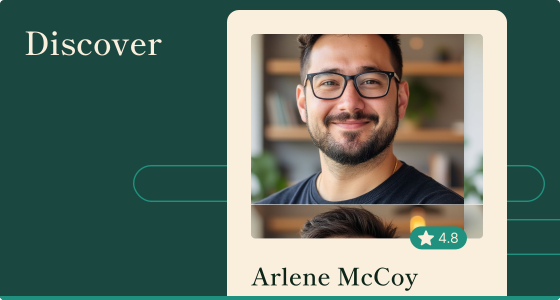
Fill out the quick form or book a discovery call. Share your team's goals, skill gaps, and preferred format – whether it's a focused 2-hour session, a half-day deep dive, or a full-day intensive.
Based on your requirements, we shortlist 2-3 workshop hosts from our vetted network. You'll get their profiles, past workshop topics, and reviews – then pick the one that fits best.

Your host tailors the curriculum to your team's context. They'll align on agenda, exercises, and outcomes ahead of time so there are no surprises – just a session that delivers exactly what you need.

Your team gets a hands-on, interactive session led by a real practitioner. After the workshop, you'll receive materials, action items, and optional follow-up sessions to reinforce what was learned.
Choose a format that fits your team's needs and schedule. Every workshop is fully customizable.
Presentation skills directly affect revenue, team alignment, and career progression - yet most professionals never receive formal training. Eight out of ten professionals prefer to avoid giving presentations entirely, according to research cited by Harvard Business Review, and the ones who don't avoid them often deliver forgettable ones. A structured workshop closes the gap between knowing your material and actually landing it with an audience.
The business case isn't abstract. Teams that invest in presentation skills training report shorter sales cycles, more persuasive pitches, and fewer meetings where half the room checks out. Despite this, most companies spend training budgets on technical skills and leave presentation ability to chance.
When a soft skills mentor isn't already part of your team's development plan, presentation skills in tech are one of the highest-return places to start.
A presentation skills workshop covers five core areas: content structuring, delivery mechanics, audience engagement, visual design, and anxiety management. Most teams assume they only need help with slide design. The reality is that weak presentations almost always fail on structure and delivery first.
The best workshops teach these skills as an integrated system, not a checklist. Here's what each area involves and why it matters for your team's performance.
How you structure a presentation determines whether your audience follows your argument or zones out by slide three. Workshop hosts teach frameworks for building a talk around a central message - opening with a hook, building logical progression, and closing with a clear takeaway. Participants restructure their own upcoming presentations during the session, not abstract exercises.
The most common structural failure isn't missing content. It's too much content with no clear throughline. Participants practice trimming, sequencing, and building presentations that move an audience from "why should I care" to "what do I do next." Teams that structure presentations around one core argument instead of ten bullet points see immediate improvement in audience retention.
Body language accounts for a disproportionate share of audience perception. Workshop participants practice stance, gesture, movement, and eye contact with real-time feedback from an expert facilitator. Vocal dynamics - pacing, volume variation, and strategic pausing - are equally trainable.
Most professionals have never received honest feedback on how they physically deliver information. They've watched TED talks and tried to imitate what they saw. A workshop replaces imitation with personalized coaching on your specific delivery habits - which ones work, and which ones distract your audience.
Engagement isn't a personality trait - it's a set of techniques. Questioning, polling, structuring for interaction, and reading the room are all skills that improve with practice. Workshop hosts teach participants how to design moments of audience participation into their presentations rather than hoping attention sustains itself.
The difference between a presentation and a monologue is whether the audience is thinking or just sitting. Effective engagement techniques include strategic questioning, planned transitions that invite reflection, and visual design that creates curiosity rather than summarizing every point verbally.
Presentation confidence isn't something people are born with. It's a byproduct of preparation, practice, and knowing how to manage nerves. A 2023 study published in PLoS ONE found that students reported reduced anxiety and increased confidence after structured presentation training intervention.
Anxiety management in workshops goes beyond "just breathe" advice. It includes controlled exposure - delivering short presentations in a safe environment and gradually increasing complexity. Participants learn to distinguish between productive adrenaline and unproductive anxiety that derails delivery.
For teams where public speaking coaching hasn't been part of professional development, this is often the most valuable module.
Visual slide design principles - using images over text, limiting bullet points, maintaining consistent typography - are typically covered as part of the content structuring toolkit. They matter, but they're the easiest skill to self-teach. The workshop time is better spent on the four areas above.
Virtual presentations require different skills than in-person delivery - from camera presence and screen sharing to managing audience attention without physical proximity. Communication skills that work in a conference room don't automatically transfer to a video call.
Online meeting fatigue is real, and presenters who don't adapt their delivery to the virtual format lose audiences within the first five minutes. The table below breaks down why the two formats demand separate training.
| Dimension | In-person delivery | Virtual delivery |
|---|---|---|
| Audience attention span | 15-20 minutes before natural drift | 8-10 minutes before screen fatigue |
| Body language visibility | Full body visible - stance, movement, gesture all contribute | Shoulders and face only - facial expression and vocal dynamics carry more weight |
| Engagement tools available | Physical proximity, room energy, whiteboard, hand-raising | Chat, polls, screen annotation, breakout rooms, reaction buttons |
| Technical requirements | Projector or screen, reliable audio | Camera quality, lighting, microphone, stable internet, screen-sharing proficiency |
| Feedback loop | Real-time - visible nods, body language, facial expressions | Delayed - muted audiences, cameras-off defaults, chat lag |
| Pacing requirements | Natural pauses feel comfortable | Silence feels like technical failure - pacing must be tighter |
A presentation skills workshop that only addresses one format leaves your team unprepared for the other. Most teams present in both contexts weekly. The strongest workshops dedicate at least one practice round to each format so participants experience the differences firsthand.
Most presentation skills training fails because it's generic, passive, and disconnected from the participants' real work contexts. If your team has been through a presentation workshop before and can't remember what they learned, the format was probably the problem - not the topic.
Three structural issues make traditional presentation workshops ineffective:
A sales team struggling with demo delivery needs different training than an engineering team presenting technical designs to stakeholders. Off-the-shelf curricula cover the same material for everyone - body language basics, slide design rules, "tell a story" advice that hasn't changed in decades.
The problem isn't that these topics are wrong. It's that they're taught without context. When participants can't connect the lesson to their actual presentations, they forget it by the following week.
Customized workshop content - built around the presentations your team actually gives - produces stickier learning.
Presentation skill development requires multiple opportunities to present and receive focused feedback - not passive instruction (Journal of Microbiology & Biology Education, 2013). A workshop where participants sit through slides about "how to present" without actually presenting is a seminar, not a training session.
More than 80% of students felt observing peers' presentations helped identify their own improvement areas - validating the group workshop format over individual coaching alone (online peer feedback study, 2021). The coached practice model - where participants deliver real presentations and receive structured expert feedback - produces measurably better results than lecture-based training.
Evaluate presentation skills workshops on five criteria: facilitator credentials, customization depth, practice-to-lecture ratio, format flexibility, and pricing transparency. These apply whether you're evaluating a large training firm, a freelance facilitator, or a platform like MentorCruise.
Here are the five questions to ask any provider before committing:
One more thing to evaluate: who handles the logistics? Matching, scheduling, and coordination take time. MentorCruise handles the matching process and delivers a tailored proposal within 48 hours, so your team can focus on the training itself.
If you're specifically evaluating workshops for leadership teams, pairing presentation training with executive coaching on MentorCruise can reinforce the skills over time rather than treating the workshop as a one-off event.
The presentation skills your team needs depend on their role, audience, and context - executive updates require different techniques than sales demos or technical walkthroughs. A customized workshop addresses these differences instead of teaching everyone the same playbook.
| Context | Key skills emphasized | Common failure pattern | Typical duration needed |
|---|---|---|---|
| Executive presentations (board meetings, leadership updates) | Clarity, executive presence, time management, data storytelling | Overloading slides with detail instead of leading with the decision | Half-day or full-day |
| Sales presentations (demos, pitches, proposals) | Audience reading, objection handling, narrative flow, confidence under pressure | Leading with product capabilities instead of prospect pain points | 2-hour or half-day |
| Technical presentations (architecture reviews, sprint demos, stakeholder updates) | Translating complexity, visual communication, audience calibration | Assuming the audience shares the presenter's technical depth | Half-day |
| All-hands and town halls (company updates, team announcements) | Speaking to mixed audiences, storytelling, energy management | Reading from slides in a monotone | 2-hour fundamentals |
Executive presence - the ability to project authority and credibility - is a presentation skill, not a personality trait. Executives presenting to boards and leadership teams fail more often on structure and confidence than on content quality.
They know their material. What they haven't practiced is delivering it in a way that commands attention and drives decisions.
Long-term leadership coaching builds these skills over time, but a focused workshop gives teams the concentrated practice that long-term coaching supplements rather than replaces.
Sales teams typically know their product inside out. Where they fail is reading the room. A sales presentation workshop teaches participants to identify buying signals, handle objections in real-time, and adapt their narrative based on audience reactions.
The difference between a demo that converts and one that doesn't is rarely about the product - it's about the presenter. Sales teams benefit most from workshops that use their actual pitch decks and prospect scenarios rather than generic exercises.
Technical presenters face a unique challenge: simplify enough to be understood without oversimplifying enough to lose trust. Data storytelling - the ability to frame technical findings as narratives with clear implications - is the skill that separates a forgettable sprint demo from a presentation that changes a project's direction.
Audience analysis - understanding who you're presenting to and what they care about - is the foundational skill that makes every other technique effective. MentorCruise workshop content is customized per team, so an engineering team presenting to stakeholders gets different training than that same team presenting to other engineers.
A strong workshop covers five core areas: content structure, delivery mechanics (body language, vocal dynamics, pacing), audience engagement techniques, visual slide design, and presentation anxiety management. The best workshops also include Q\&A handling and feedback sessions where participants practice with real presentations. Look for providers that customize the curriculum to your team's actual challenges rather than running a generic program.
Presentation skills workshops on MentorCruise start at $250 for a 2-hour fundamentals session, $500 for a half-day deep dive, and $900 for a full-day bootcamp. Pricing is published upfront with no consultation calls required. For comparison, some providers charge $1,500+ per person for a 2-day course, and most require a sales conversation before showing any pricing at all.
Yes, when the workshop includes structured practice with expert feedback. Presentation skill development requires multiple opportunities to present and receive focused feedback (Journal of Microbiology & Biology Education, 2013). Passive lecture-format workshops don't produce the same results.
Look for workshops where at least half the time is spent on participant practice, not instruction.
Presentation skills training covers the full toolkit - content structure, visual design, delivery mechanics, and audience engagement - typically in a team setting. Public speaking coaching focuses specifically on speech delivery, stage presence, and speaker confidence, usually one-on-one.
A workshop addresses both but emphasizes the professional context: presenting to colleagues, clients, and stakeholders rather than delivering keynotes or conference talks.
It depends on your team's goals. A 2-hour fundamentals session works for a refresher or teams that already present regularly. A half-day deep dive (4 hours) gives enough time for skill building with at least two rounds of practice and feedback.
A full-day bootcamp (6-8 hours) suits teams building presentation skills from scratch, with multiple practice rounds and personalized coaching.
Request a presentation skills workshop and get matched with a vetted expert within 48 hours. Every workshop host has passed an 8% acceptance screening - these are practitioners from companies like Google, Adobe, and Meta, not career trainers reading from a script.
Workshops start at $250 with transparent, per-workshop pricing. No hidden fees, no sales calls, no multi-week procurement process.
Ready to run a presentation skills workshop your team will actually remember? Request a workshop and get a tailored proposal within two business days.
Our hosts are experienced professionals from leading companies who bring real-world expertise to every session. Here's a sample of who's available.

Senior Product Designer at Mastercard

Bilingual Senior Solutions Architect

Senior Manager at Uber

Senior Software Engineer at Offchain

Principal Applied Science Manager at microsoft

Partner Growth Marketing Manager at Expedia Group

Solution Engineer at Atlassian

UX Manager at YouTube
See all our corporate training programs – AI tools, leadership, sales, marketing and more.
Reviews

Andrei has been an amazing mentor, helping me navigate the challenges of managing an engineering team, modernising our legacy SaaS platform and moving us into the era of AI software development.
Patrick
Director, Strategic Projects

Alessandro taught me to use competency matrices as objective decision-making tools, challenge assumptions from my own teams, and translate technical language into management language for executive conversations.
Roman
Engineering Manager

Matthew helped me think through several tricky leadership moments – particularly around how to navigate executive relationships, clarify influence, and prepare for a high-stakes offsite. I left each session clearer, calmer, and more confident in how I was showing up at the executive level.
Kimmy
Director of Team Enablement
Ready when you are
Tell us your goals and team size. We'll match you with 2-3 vetted hosts within 48 hours.



