Pick the right CRM certification, prep with a mentor who has already passed it, and put it to work in your next role. Updated for 2026.
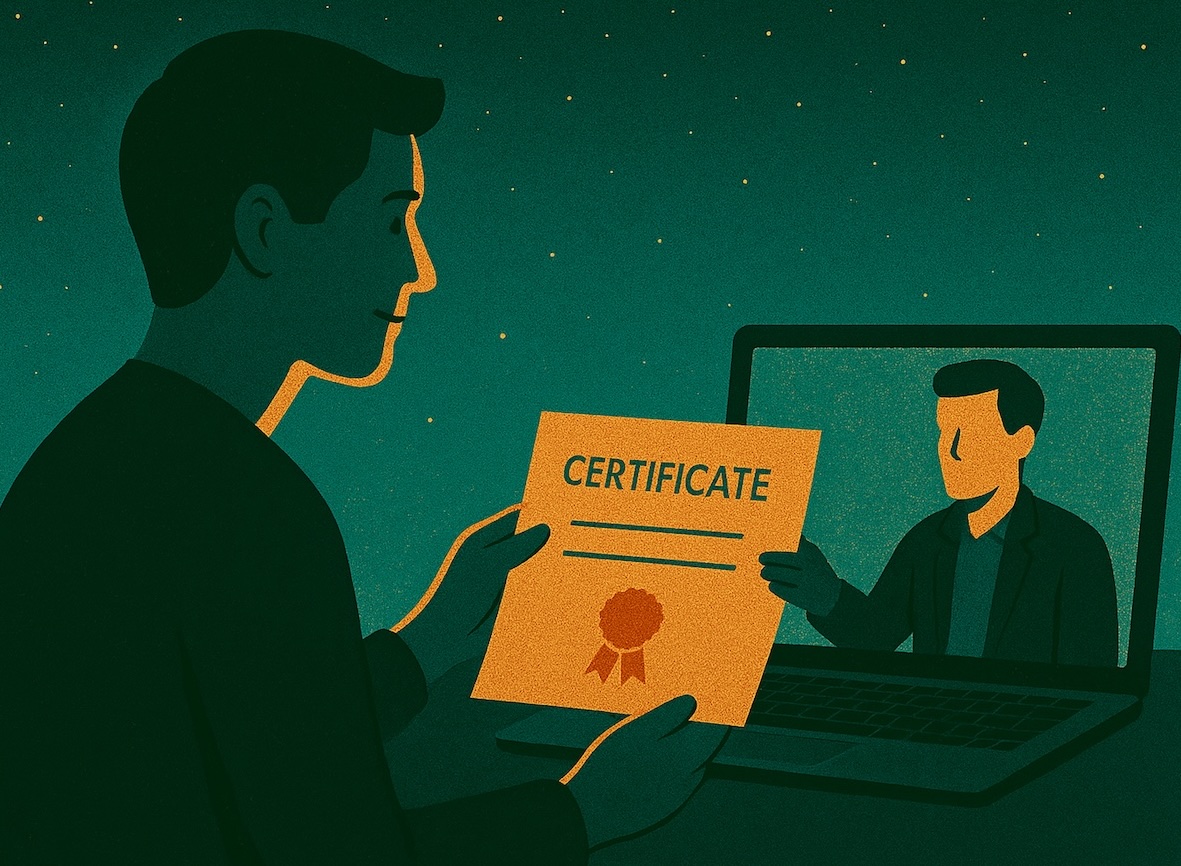


6+ CRM mentors available
Get matched with one who has already passed your exam






Anyone can sign up for a certification course. But getting certified – and putting that knowledge to work – takes more than reading slides. A long-term mentor keeps you focused and gets you across the finish line faster.


Vetted CRM experts, available for 1-on-1 prep right now
The best CRM certification depends on your current role and target job. Most professionals start with a foundational CRM cert to validate core skills, then move to a role-specific track. Pairing exam prep with a CRM mentor on MentorCruise cuts study time and turns the cert into real, applied skills.
Last reviewed: October 2026 · Based on 11 CRM certifications recommended by working mentors.
The 10 industry certs below, plus MentorCruise itself as the 1-on-1 prep path most mentees pair with whichever one they pick. Each cert is paired with prep notes from someone who has already passed it. Not sure which to start with? Talk to a CRM mentor first – the wrong cert costs you months.
Zoho CRM streamlines the day-to-day operations of thousands of businesses around the globe, every single day. Our instructor-led training programs are designed to help you get the most out of your subscription. Designing pristine software is only part of our job—helping you master it is the other.
Consider reaching out to a coach specialized in CRM certifications. They can help you prepare for your exam, and provide you with the necessary resources to succeed. MentorCruise is the best place to find a coach for your CRM certification.
HubSpot Academy is an online training platform provided by HubSpot, a leading provider of inbound marketing, sales, and customer service software. The Academy offers a variety of courses, certifications, and resources designed to educate users on inbound marketing techniques, HubSpot's software pro…
The Salesforce CRM Masterclass in the United Kingdom is an intensive training program designed to equip participants with advanced skills and knowledge in Salesforce Customer Relationship Management (CRM) software. Prices start at £ 3'885.00.
Candidates should be able to set up and implement the tools in Salesforce Marketing Cloud effectively, providing solutions to execute both tactical and strategic email campaigns.
The NetSuite Certification program offers businesses the opportunity to develop accredited, expert-level in-house NetSuite support. Through multiple certification options, participants gain valuable skills and know-how to better support their user base. Thousands of people have earned accreditation…
Consider joining a workshop specialized in CRM. Workshops are a great way to learn new skills, and get hands-on experience. MentorCruise is the best place to find a workshop for your CRM certification.
Salesforce Administrator (ADM-201) certification exam is for the candidates who have knowledge of salesforce community and want to add more knowledge to their skill set to serve their company in a better way. Salesforce is actually a customer relationship management software that bring companies an…
The System Architect is responsible for defining and communicating a shared technical and architectural vision for the solutions developed by an ART.
Salesforce Architects are highly skilled professionals who specialize in designing and implementing complex Salesforce solutions tailored to meet specific business needs. They play a crucial role in ensuring that Salesforce implementations are scalable, efficient, and aligned with the overall strat…
From onboarding to adoption and optimization, our online training, credentialing, and certification program levels up your team’s Zendesk expertise.
Oracle CRM On Demand certifications are designed for professionals who work with Oracle's cloud-based CRM solution, Oracle CRM On Demand. These certifications validate expertise in implementing, configuring, and managing Oracle CRM On Demand environments, which are crucial for organizations looking…
A CRM cert is a starting point, not a finish line
A certificate proves you can pass an exam. A mentor proves you can apply the work. Most of our mentees pair their CRM cert with weekly 1-on-1 sessions so the knowledge sticks – and translates into a promotion, a new job, or a real project shipped.
There is no better source of accountability and motivation than having a personal mentor who has already passed the cert you're studying for. All mentors are vetted, certified, and hands-on.
Explore a curated network of vetted mentors – engineers, designers, founders, and more. Find someone who matches your goals, skills, and budget.
Choose a flexible plan that fits your pace – whether it's Q&A chats, regular calls, or something in between, your mentor will help you build a personalized roadmap.

Get ongoing support through regular calls, check-ins, and feedback. Your mentor stays with you for the long haul.

Mentees who stick with their mentor for 3+ months reach their goals 2x faster than they would on their own. Fewer dead ends, more breakthroughs.
A mentor who has already passed the CRM cert can spot weak areas in your prep, point you at the exam topics that actually matter, and save you a re-sit fee.
Cut down on failed attempts, abandoned courses, and bootcamp upsells. Work directly with someone who knows what worked and what didn't.

Self-paced learning is easy to drop. Mentorship adds structure and momentum, so you actually finish the cert you started.

Mentors help with more than the exam – they review portfolios, coach for interviews, and translate the cert into a promotion or new role.
CRM certifications prove you can configure and run a specific customer relationship management platform to a standard an employer recognizes. Each is tied to one vendor system like Salesforce, HubSpot, or Microsoft Dynamics 365, so a CRM certification is a platform credential, not a universal qualification. CRM here means Customer Relationship Management software, not Certified Risk Manager.
These credentials are built for sales, marketing, and customer service professionals who want their platform skills validated before they apply for CRM-focused roles. That covers administrators, functional consultants, revenue-operations staff, and career changers moving into sales tech. The common thread is a job that runs on a CRM every day, where the employer needs proof you can operate the tool from day one.
The hard part is choosing well. Certifications span seven-plus ecosystems, range from free to a few hundred dollars, and only pay off when they match the platform your target employers actually run. The sections below give you the side-by-side comparison the ranking guides collect but the page above does not, the honest return behind "is it worth it," and where a mentor fits once the badge is in hand.
CRM certifications vary most on cost, validity, and prerequisites, so a side-by-side comparison is the fastest way to rule options in or out. The table below covers seven credentials sales, marketing, and support professionals actually shortlist, with the vendor-published facts the ranking guides collect but rarely put in one place.
| Certification (issuer) | Cost | Format and exam | Prerequisites | Validity / recert | Level |
|---|---|---|---|---|---|
| Salesforce Certified Administrator, ADM 201 (Salesforce) | About $200 plus tax | Proctored, 60 questions | About one year of hands-on Salesforce use recommended | Annual Trailhead maintenance modules | Entry administrator |
| HubSpot CRM certification (HubSpot Academy) | Free | Online course plus exam | None | Renews every two years | Foundational |
| Microsoft Dynamics 365 Fundamentals, CRM (Microsoft) | About $99 | Proctored exam | None | 12-month renewal | Foundational |
| Dynamics 365 Functional Consultant Associate, Sales or Customer Service (Microsoft) | About $165 | Proctored exam | Product knowledge and role experience recommended | 12-month free online renewal | Associate / intermediate |
| Zoho CRM Certified Consultant (Zoho) | Free application | Application and portfolio review | Three or more paid Zoho consulting projects | Lifetime | Consultant / advanced |
| Zendesk Support Administrator Expert (Zendesk) | About $350 | Proctored exam | Hands-on admin experience recommended | Periodic recertification | Expert |
| Oracle NetSuite Administrator (Oracle NetSuite) | About $250 | Proctored exam | SuiteFoundation certification | Annual product-update recertification | Administrator |
You'll find 6+ CRM mentors on MentorCruise who already hold these exact credentials, so the person reviewing your prep has passed the same proctored exam you are studying for. The fees above are each vendor's own published exam price, not a MentorCruise charge, and they change, so confirm the current figure on the vendor's site before you book.
Two columns decide most of the shortlist. Cost tells you the entry price, but validity tells you the running cost, because a credential that lapses after 12 months without a maintenance module quietly expires on your resume.
Prerequisites are the other filter: the free options are not always the easy options, since Zoho's Certified Consultant asks for paid project history that a beginner will not have. Read the table by your own experience level first, then by budget.
The CRM you certify in should match the platform your target employers already run, because a credential in a system nobody near you uses buys very little. Start by reading job descriptions in your target market and counting which platform shows up most, then certify in that one rather than the one with the flashiest reputation.
HubSpot tends to win at companies under roughly 500 employees and in marketing-led teams, which makes the free HubSpot Academy credential a low-risk first step for that segment; if marketing operations is your lane, a marketing mentor can point you at the right track.
Salesforce dominates mid-market and enterprise, so the Salesforce Certified Administrator is the safest bet when you are aiming at larger organizations. Microsoft Dynamics 365 is the default in Microsoft-heavy shops that already run Office and Azure, where a Dynamics functional consultant credential travels well.
Support-led organizations are a separate case. Teams built around a help desk often standardize on Zendesk or Freshdesk, so a customer service professional there is better served by a Zendesk or Freshdesk administrator credential than by a sales-CRM exam. Zoho suits budget-conscious small businesses, though its Certified Consultant route assumes you have already delivered paid projects, which makes it a poor first certification for someone breaking in.
A course certificate proves only that you finished a class. A proctored vendor certification proves you passed the vendor's own graded exam, and employers weight the second far more heavily. The distinction trips up buyers because both arrive as a PDF with your name on it.
A completion certificate from a Coursera or LinkedIn Learning CRM course shows you watched the material and passed the quizzes. A vendor certification like the Salesforce Certified Administrator or a Microsoft Dynamics 365 exam is proctored, scored against published objectives, and tied to a validity period you have to maintain. When a recruiter searches for "Salesforce Certified" on a resume, the course certificate does not clear that filter.
That does not make courses worthless. A well-built course is often the best way to learn the material before you sit the real exam, and several vendor learning paths are delivered as free courses. The rule is simple: take the course for the knowledge, but treat the proctored vendor certification as the credential employers are screening for.
Yes, a CRM certification is worth it in 2026, mainly to clear the resume filter and get into the field, but the credential carries little advantage on its own until you convert it into real work. The honest answer is yes, with caveats.
It signals baseline platform fluency an employer would otherwise have to take on faith, and it gets your application past the automated keyword screen. What it does not do is prove you can run the platform under pressure, so the value depends entirely on what you do with it after you pass.
A CRM certification pays off fastest when you are breaking into the field, because it gives a hiring system a concrete reason to read your resume instead of screening it out for a missing keyword. For a career changer or a junior applicant, that first filter is the whole game, and a recognized administrator credential clears it.
The signal is strongest at the entry point for a simple reason: the employer has nothing else to go on yet. A Salesforce or HubSpot certification signals to a hiring team that you can operate the platform, grasp how its objects and workflows connect, and won't need weeks of hand-holding on the basics. That is worth real money to a hiring team, even though the certificate itself proves competence, not performance.
Pairing the credential with structured guidance closes that competence-to-performance gap faster, and mentees on MentorCruise report a 97% satisfaction rate with that kind of accountable prep. If your resume itself is the weak link rather than your platform skills, professional resume coaching is a cheaper fix than sitting a second exam you do not need.
The credential stops moving the needle once the platform is already on your resume, because a second badge in a system you clearly already know adds no new information for an employer. At that point another certificate rarely moves your salary, and the honest limitation is that an exam cannot test the judgment a hiring manager is actually screening for.
What advances a CRM career from here is demonstrated work: shipped configurations, solved edge cases, and depth in advanced tracks like Salesforce Architect. Interviewers probe for that experience directly, and preparing for the Salesforce interview process rewards stories about real builds far more than another line of credentials.
So the return curve bends early. The first certification can change your career by opening a door that was closed; the third rarely changes anything an employer can see. The credential clears the filter, and on its own it carries little advantage until you turn it into work someone can point to.
Start with the vendor's own exam guide and finish with hands-on practice in a free trial org, because these are configuration exams, not read-the-docs tests. Reading alone fails people who have never clicked through the actual admin screens. Follow a sequence that builds practice in from the start:
Because MentorCruise plans come in Lite, Standard, and Pro tiers, you can start light during self-study and scale up as the exam nears, with the freedom to cancel or switch anytime. Step five matters because a config-heavy exam rewards a second pair of eyes on your work, which self-study can't give you. A mentor who has sat the same exam knows which objectives the vendor tests hardest, so your study time goes where the exam actually weights it.
A certification proves you covered a platform; a mentor who has done the job proves you can run it. That distinction is the gap between clearing the resume filter and landing the better-paid role. The exam validates recall and basic configuration, while the mentor builds the judgment, the portfolio, and the interview stories that convert a credential into an offer.
A certification proves you passed an exam. It does not prove you can run the platform under real pressure. The test asks you to identify the right setting; the job asks you to decide which of three imperfect configurations survives contact with a sales team that will not change its habits.
That judgment is what an exam cannot score. It comes from working real problems with someone who has already solved them, which is why every MentorCruise mentor is hand-screened and approved, and CRM mentors have passed the certification themselves. Live sessions, async review, and weekly check-ins turn config practice into the kind of decisions the job demands.
A mentor also catches the mistakes a passing score hides, like an automation that works in a clean trial org but breaks the moment real data and real users hit it. A free intro call plus a money-back guarantee let you test-fit a mentor before you commit, so the downside of trying is close to zero. If you are switching careers into sales tech, a career transition mentor can map the whole path rather than just the exam.
A mentor who has passed the cert turns it into the promotion by coaching you through the part the exam never touches: proving, in an interview and on the job, that you can actually run the platform. The credential opens the door, and the mentor helps you walk through it with work to show.
Dan Ford spent 15 years in tech recruiting, reading thousands of resumes and running hundreds of interviews, before he started mentoring on MentorCruise. That vantage point is exactly what converts a credential into an offer: he has seen which candidates get hired past the resume filter and which get screened out despite the badge, and the mechanism transfers directly to CRM roles. See Dan's mentor profile for how a recruiter thinks about turning a certification into a hire.
The payoff shows up in the numbers that matter: mentees who stay three or more months reach their goals about 2x faster than those going it alone. Working with an experienced sales mentor who holds the same credential you are chasing is how the certificate stops being the finish line and becomes the floor you build a career on.
A free intro call is the low-risk way to find a mentor who has already passed your target exam, before you commit to a single paid session. The badge gets you read; the mentor gets you hired.
Get a free foundational certification first if you are new, such as HubSpot or Dynamics 365 Fundamentals, then the Salesforce Certified Administrator once you have hands-on experience. Your first pick should follow your target employers' platform, so check which CRM shows up most in the jobs you want.
A CRM certification costs anywhere from nothing to about $350, depending on the vendor. HubSpot, Zoho, and Freshdesk offer free credentials, while proctored vendor exams run roughly $99 for Microsoft Dynamics 365 Fundamentals, $200 for Salesforce Administrator, $250 for NetSuite, and $350 for Zendesk. Prices exclude tax and change over time, so confirm the current figure on the vendor's site.
Yes, a CRM certification is worth it in 2026 to clear the resume filter and enter the field, but the real return comes from converting it into demonstrated work. The credential proves baseline platform fluency, and a career jump follows from shipped configurations and interview-ready experience. A mentor who has done the job adds the most there.
Advanced Salesforce tracks carry the most career weight, with the Architect and technical consultant credentials sitting at the senior end and commanding the strongest roles. The Salesforce Certified Administrator is the most widely recognized entry credential. Weight follows seniority and market demand, so match the level to where you are in your career rather than chasing prestige.
Getting a CRM certification usually takes about 6 to 16 weeks, depending on the exam and your starting point. Foundational credentials like HubSpot or Dynamics 365 Fundamentals sit closer to 6 weeks, while a proctored Salesforce Administrator exam lands in the upper half of that range. Consistent daily practice in a free trial org is the biggest factor.
Spots are limited


"My mentor had passed the exact cert I was studying for. I passed on the first try and walked into the role three weeks later."
Free to browse · cancel anytime
Frequently asked
The questions CRM mentees ask most before picking a certification and starting prep.
Start with a foundational CRM certification if you're new to the field – it validates core concepts and is recognized everywhere. If you already have hands-on experience, jump to a role-specific or associate-level track. A CRM mentor can look at your background in one session and tell you which cert is the right starting point.
Most CRM certifications take 6 to 16 weeks of structured prep, depending on your starting point and the cert level. Foundational exams are closer to 6 weeks. Professional and specialty exams run longer. Mentees with weekly mentor sessions typically finish in the lower half of that range.
Yes, when paired with applied work. A CRM certification opens recruiter pipelines and signals baseline competence – hiring managers still look for evidence you can use the skill on real projects. That's why mentees who get certified alongside mentor-led portfolio work move into roles faster than those who only have the cert.
MentorCruise plans start at $120/month, which is roughly 70% less than most cert bootcamps. You get weekly 1-on-1 sessions with a CRM expert plus async messaging between sessions. Cancel anytime – you're not locked into a multi-month bootcamp contract.
Courses give you a curriculum. A mentor gives you a curriculum, accountability, and a feedback loop on the gaps you didn't know you had. Most mentees pair both – they consume a self-paced course and meet with a mentor weekly to debug their understanding. Pure self-study works for some, but completion rates are much lower.
Yes. Most MentorCruise mentors do production CRM work day-to-day. They'll guide you through portfolio projects, code reviews, architecture decisions, and the kind of real-world judgment calls that an exam can't test for. This is what closes the gap between "certified" and "actually employable".
A failed attempt is information, not a verdict. Most cert programs let you re-sit after a short waiting period. Your mentor will help you read the score report, identify which knowledge domains you missed, and rebuild the prep plan around those gaps. Mentees who fail once and re-sit with a mentor usually pass the second time.
Weekly 1-hour sessions are the sweet spot for most CRM certification tracks. It's frequent enough to stay accountable and unblock confusion early, but not so frequent that you don't have time to study between sessions. Bi-weekly works for longer prep cycles or part-time learners.
Account Executive at Embat

Founder at Mean Decisions
Solutions engineer at Microsoft

Director of Sales at HubSpot

Salesforce Sr. Director + ex-hiring manager

Staff Comunity Lead at Fortis Games
Account Executive at Embat
Founder at Mean Decisions
Solutions engineer at Microsoft
Director of Sales at HubSpot
Salesforce Sr. Director + ex-hiring manager
Staff Comunity Lead at Fortis Games
We've already delivered 1-on-1 mentorship to thousands of students, professionals, managers and executives. Even better, they've left an average rating of 4.9 out of 5 for our mentors.
Find a CRM mentor